Choosing the Best Machine for Safe Incline Mowing
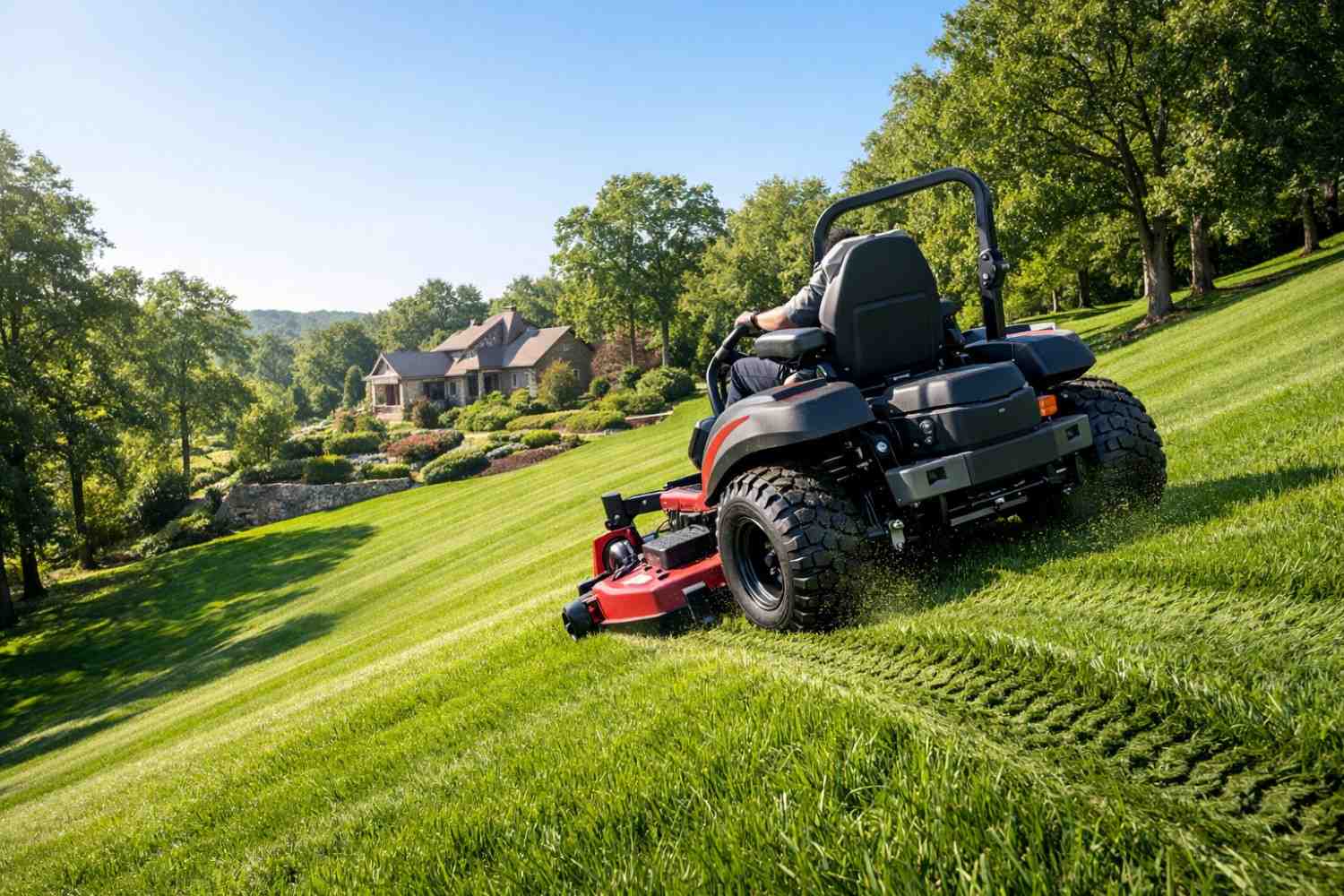
Mowing an incline changes the weight distribution of your machine. When you navigate a standard lap-bar zero-turn mower over a steep hill, the front casters pivot freely, causing the machine’s front end to swing downhill. Not only do you lose your cutting line as a result, but you also risk a complete rollover hazard.
When safety comes into the equation, a few key factors should be considered to properly manage your hilly terrain:
- The 15-Degree Rollover Threshold: According to safety evaluations compiled by the National Association of Landscape Professionals (NALP), riding mowers should never exceed a 15-degree incline, while walk-behinds shouldn’t surpass 20 degrees.
- Drive Configuration Weights: Rear-wheel drive pushes down onto the turf as you climb, which increases tire bite. Lap-bar zero-turns rely purely on independent rear wheel speeds for steering; on a slope, the downhill wheel bears the load which forces the uphill wheel to lose traction and spin out.
- Wet Turf Hazard: A damp hillside can reduce tire friction by over 50%. A machine that holds perfectly on dry turf in June can give way to an uncontrollable slide on morning dew.
Mow a Steep Slope, Step-by-Step
Of course, the folks at Catoe’s Power Equipment know as well as you do that potential safety hazards don’t mean you need to leave your hills alone. So when it comes to mowing challenging terrain, assuming your machine meets the requirements, we’ve put together a step-by-step guide:
-
Measure Your Slope
Before starting on a mow, download a digital incline/clinometer smartphone app. Lay a straight 2×4 piece of lumber down the steepest portion of your hill and place your phone flat on top of it to check the exact degree of the angle. Guessing a hill is 10 degrees when it’s actually 18 degrees puts you past the tipping point of standard consumer riding equipment. Don’t take the risk!
-
Choose Your Direction Strategy
If you are operating a riding lawn tractor or commercial stand-on unit, always mow straight up and down the hill, never sideways. If you’re rocking a walk-behind push mower, always mow horizontally across the face of the slope. Moving across the face ensures that, even if you lose footing, your machine stays clear of your body path.
-
Maintain a Wide, Low Stance
When maneuvering around trees or changing directions on a slope, keep all your turning motions smooth and slow, as well as pointed downhill. Abrupt, high-speed shifts while facing side-hills are the leading root cause of OSHA-documented crushing accidents. Keeping your speed low prevents centrifugal force from breaking your tire traction and causing injury.
Catoe’s Power Equipment is Your Local Answer!
South Carolina terrain is rarely uniform and, as a result, finding the right mower is about matching your equipment to the exact shape of your land.
This is exactly why Catoe’s Power Equipment is the ultimate answer for any homeowner or commercial contractor dealing with tricky hillsides. Located at 4012 W Beltline Blvd, Columbia, SC 29204, Catoe’s has spent more than four decades tailoring machinery choices to South Carolina’s distinct soil and terrain profiles!
We carry the top names in the industry, such as Ariens, Gravely, and Toro, alongside highly competitive financing plans that are designed to fit your budget! Have your top pick at a price that works for you.
Don’t risk your safety on equipment that isn’t built for the job. Visit Catoe’s Power Equipment in Columbia to speak with our specialists and find the ideal, high-traction machine for your property. Contact us today!